


We are surrounded by a tempting promise: give people better AI tools and the business will become better, too.
Sometimes the tools do help. A report takes less time to draft. A developer gets to a first implementation faster. A service representative finds an answer without searching through ten pages. These improvements can be real and useful.
But imagine that every one of those faster tasks still feeds the same overloaded approval queue, the same conflicting databases, and the same decisions that nobody clearly owns. We have accelerated the activities without necessarily improving the system.
My view is that the most important change in the AI era is not a new tool. It is the willingness to question how work is designed in the first place.
That is what I mean by a mindset shift. Not enthusiasm. Not an instruction to “embrace AI.” A practical change in the questions leaders and teams are prepared to ask.
We can adopt a tool without changing the business
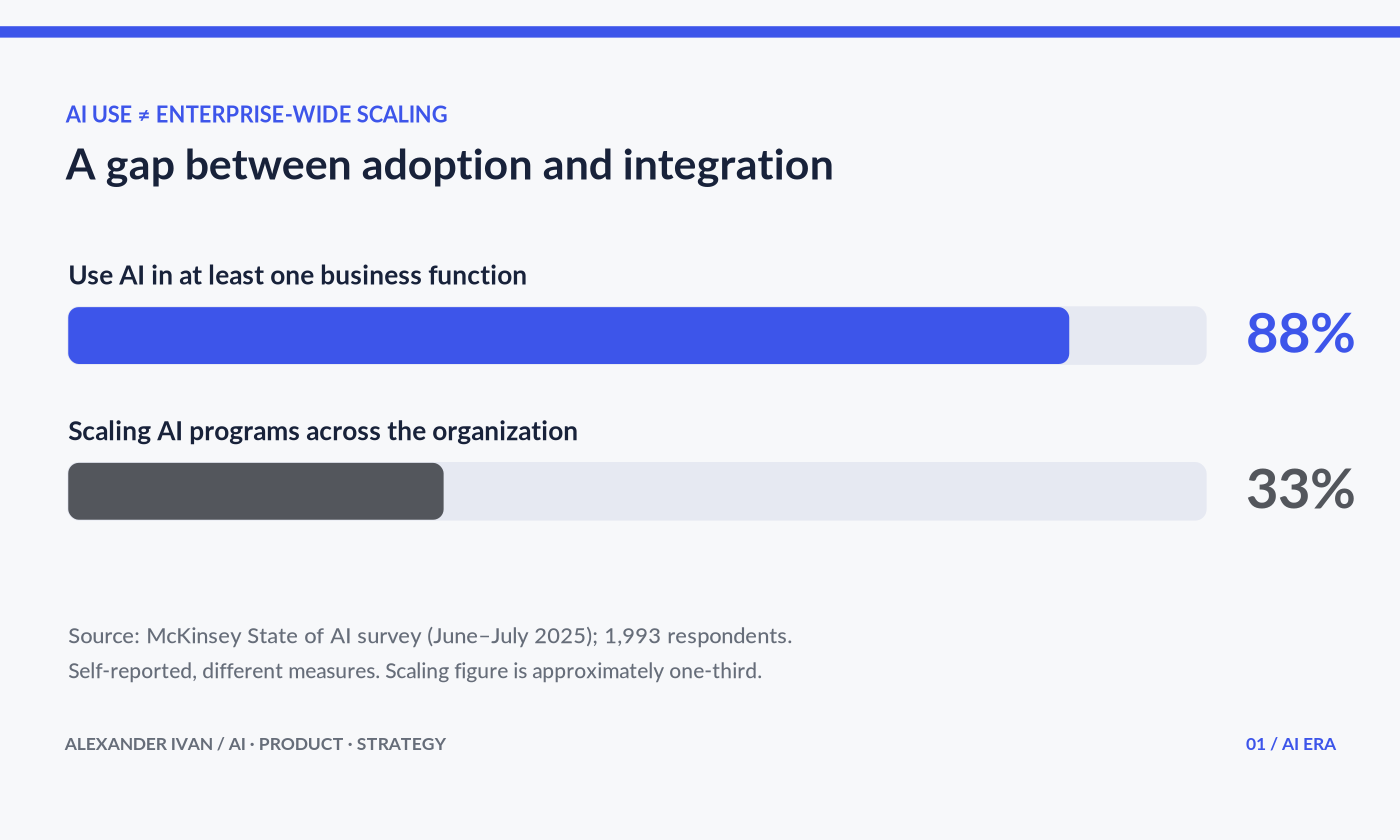
The distinction is visible in the available research. In McKinsey’s 2025 State of AI survey, 88% of respondents said their organizations used AI in at least one business function, but only about one-third said their companies were scaling AI programs across the organization. These are different self-reported measures, not a controlled study of what caused business results. Still, they illustrate the distance between using a capability somewhere and integrating it across an enterprise. [1]
The first question a leader should ask is not “Which AI tools have we introduced?” It is “What is meaningfully different because we introduced them?”
If a team creates documents 40% faster but customers wait just as long, the improvement may be trapped inside one step. The 40% is a hypothetical example, not a claimed result from my work or a figure from that survey. The business may need something other than a faster document.
That leads to three mindset changes I think are worth making.
1. From choosing tools to defining outcomes
A tool-first conversation begins with what a model can do. An outcome-first conversation begins with an unresolved business problem.
Take a customer-support process. We could ask AI to summarize incoming tickets. That might save effort. But what is the actual problem: slow first response, incorrect routing, incomplete knowledge, repeat contacts, or customers not getting a resolution?
Those are not interchangeable. An excellent summarizer may do little for a team whose main constraint is waiting for another department’s approval.
Start with a precise outcome: reduce the time from first contact to a correct, complete resolution without increasing reopens or customer harm. Then examine where AI could help—and where data quality, permissions, handoffs, or policy are the real constraint.
The point is not to reject AI tools. It is to give them a business job.
2. From accelerating tasks to redesigning the workflow
When AI makes an individual task easier, the instinct is to automate more tasks. But a business outcome usually crosses several steps and teams.
Consider an illustrative support workflow:
Before: a customer submits a request → someone reads it → someone routes it → an agent searches for context → another person approves an exception → the agent replies.
Possible redesign: classify the request → retrieve trusted information → suggest a response or next action → apply clear confidence and risk rules → route sensitive cases to a responsible human → record whether the customer was actually helped.
This is a design example, not a claim that I deployed it or that it works without testing. The redesigned flow may be better, or it may expose new failure modes. It must be validated against real customers and real constraints.
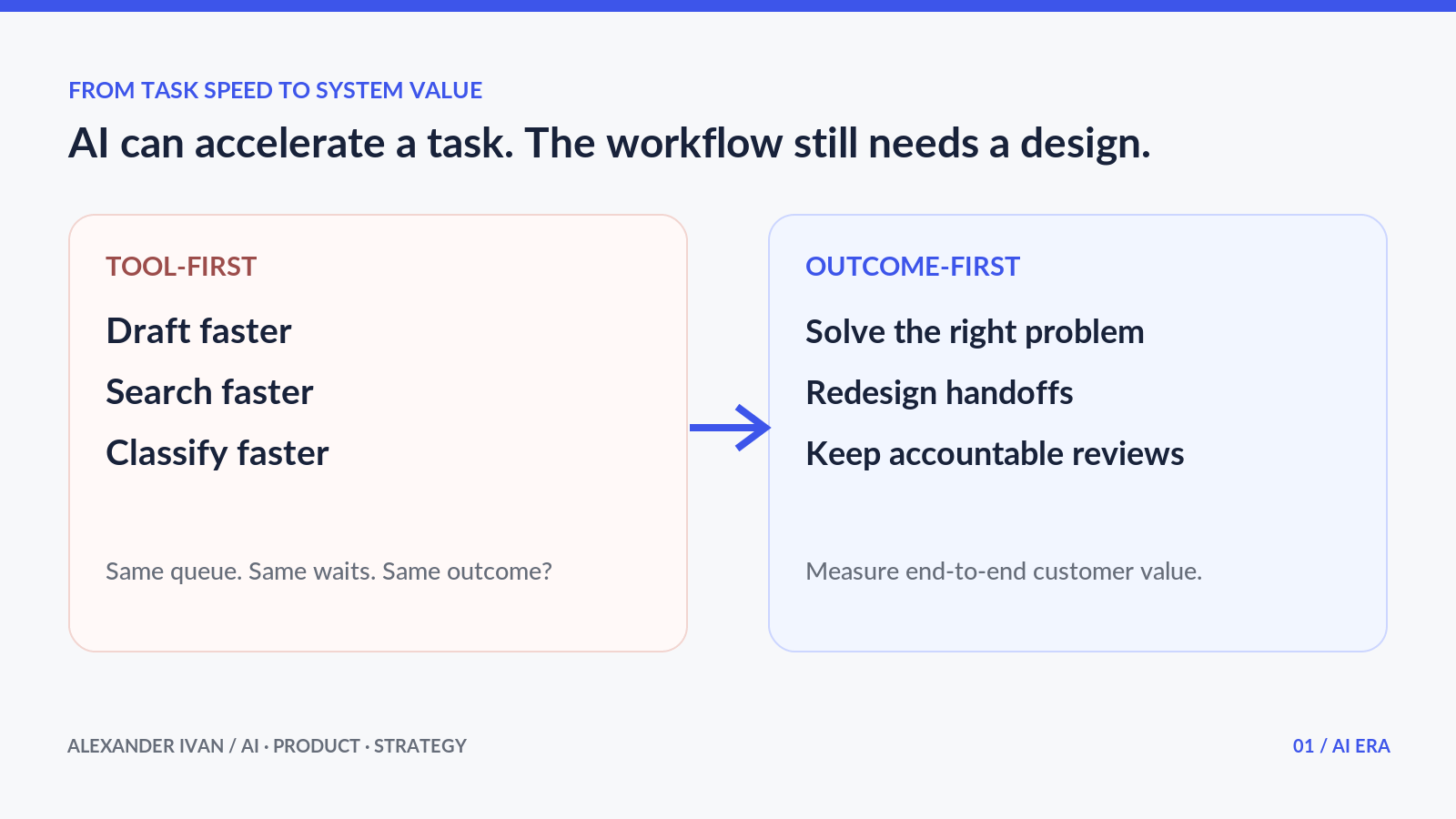
The hard part is rarely drawing the boxes. It is agreeing who owns the outcome, which information can be trusted, where the human check belongs, and what happens when the model is wrong.
McKinsey’s survey found that organizations its researchers classified as higher AI performers were much more likely than others to report substantial workflow redesign. That is an association, not evidence that redesign alone caused the difference. But it is consistent with a useful operating hypothesis: changing a process can matter more than adding another assistant to an unchanged process. [1]
3. From confident plans to disciplined learning
AI changes quickly. That creates pressure to have an AI strategy that sounds decisive and complete.
I prefer a strategy that is clear about the business objective and honest about what has not been proven.
For a reversible, low-risk experiment, I would rather ask “What is the smallest test that could change our decision?” than demand a perfect architecture before anyone learns from the work. For a high-stakes application, I would demand more rigorous controls before exposing people to harm. Those two positions are compatible.
A useful mindset allows both exploration and restraint. Teams should be able to challenge existing processes, test new possibilities, and also stop an initiative when costs, reliability, security, compliance or user outcomes do not justify it.
The U.S. National Institute of Standards and Technology offers a helpful reminder: its AI Risk Management Framework organizes risk work around govern, map, measure and manage. It treats risk management as an ongoing practice rather than a one-time approval. [2]
Mindset matters. It is not enough.
This is where conversations about “AI culture” often become too vague.
A willingness to experiment is useful. But enthusiasm cannot repair unusable data. It cannot settle unclear decision rights, create a missing escalation route, or resolve contradictory incentives.
For an AI-driven improvement to survive contact with real work, several elements need to connect:
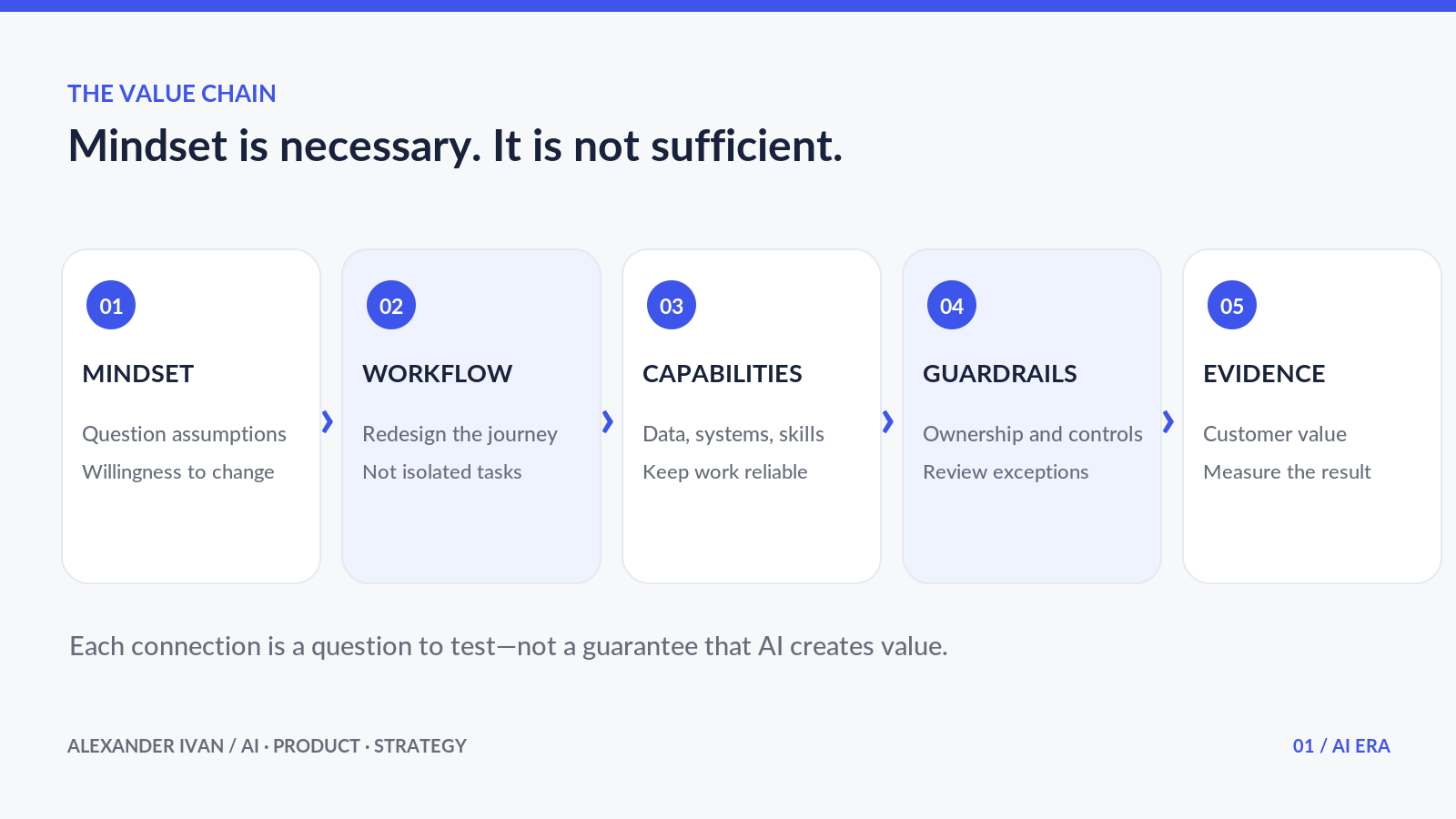
Mindset: Are people willing to challenge the current method and consider a different one?
Workflow: Can we redesign the end-to-end journey instead of optimizing an isolated task?
Capabilities: Do we have reliable information, integration points, skills, and a maintainable technical foundation?
Guardrails: Who owns the decision, reviews risk, handles exceptions, and can stop the system?
Evidence: Did the result improve for customers, employees and the business, net of cost and quality trade-offs?
If one of these is missing, more powerful models may not fix it. For leaders, that is the uncomfortable—and productive—part of AI transformation. It is an organizational design problem as much as a technology decision.
A practical starting point for a leadership team
I would begin with one recurring workflow, not an enterprise-wide declaration that everything must change.
Name the outcome. What matters at the end: resolution time, error rate, customer effort, throughput, quality or cost?
Map the real work. Include the waiting, handoffs, rework, decisions and exceptions—not only the visible task.
Locate the constraint. Is AI the likely solution, or does the problem sit in rules, incentives, unclear ownership, or missing data?
Design a bounded test. Decide what will change, who is accountable, how errors are reviewed, and when the experiment stops.
Compare the result. Look at the end-to-end outcome and unintended costs. Keep, adapt, or discontinue the experiment based on what you learn.
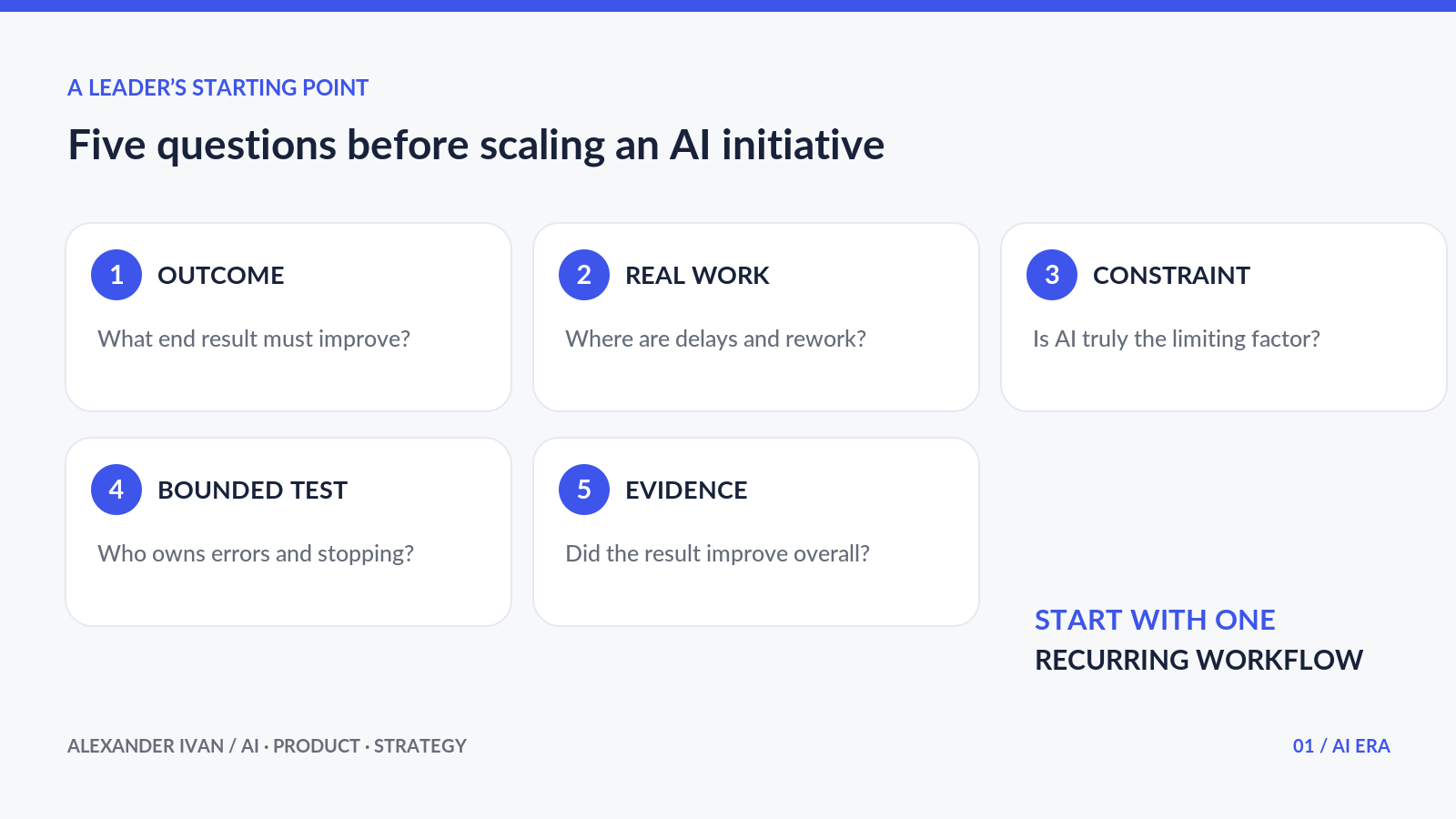
This is not a universal five-step implementation method. It is a useful way to expose the decisions that a tool demonstration can hide.
The leadership question behind the technology
After years working in software delivery and product development, I have become increasingly interested in the distance between producing output and creating value.
AI makes that distinction harder to ignore. We can now produce more first drafts, code, analyses and proposals than before. Some of that output will be valuable. Some will create more decisions, reviews or rework downstream.
I do not think the answer is to slow down innovation. I think it is to be more ambitious about what we are trying to improve—and more precise about how we will know whether we did.
The next competitive advantage may not be who has the most AI tools. It may be who learns fastest how to redesign work around real customer and business outcomes.
The question I would leave with any leadership team is simple: If we removed the AI tool from our presentation, could we still explain what needs to change in the business—and why?
I write about AI, products, strategy and what it takes to turn ideas into real value. If this is the kind of question you work through, you can follow the publication for future essays and practical field notes.
Sources and reading
McKinsey, The state of AI in 2025: Agents, innovation, and transformation (5 November 2025). Respondent survey conducted June–July 2025; adoption, scaling and performer comparisons are self-reported, associative measures.
NIST, AI Risk Management Framework Core. The voluntary 2023 framework is undergoing revision as of October 2026.
Stanford HAI, 2026 AI Index: Economy. Provides additional adoption context and cautions about self-reported organizational survey results.
Editorial note: The support-workflow scenarios and example percentages explicitly identified above are illustrations. They are not claims of outcomes achieved at Onsday or in an employer’s systems.